Our CEO Kimberley Jonsson’s star qualities are no secret at CHU so it wasn’t a surprise when Insurance Business included her in its 2023 Hot List, which represents the best of the best in the Australian insurance industry.
To determine who was honoured, the IB team carefully considered over 500 top contenders and pared them down to 50 outstanding winners – all of whom distinguished themselves through leadership and innovation over the past 12 months.
Kimberley joined the industry in 2005 and has worked across a range of areas including sales, underwriting and leadership positions. In addition to becoming a Fellow of ANZIIF, she is a member of the Australian Institute of Company Directors and holds an MBA from AIM Business School.
In 2017, Kimberley was named Young Insurance Professional of the Year at the Australian Insurance Industry Awards. In 2020, she became one of the youngest CEOs in the Australian financial services sector.
Kimberley has led CHU with determination and is passionate about driving the business forward with CHU’s three strategic pillars firmly in focus: Diversity and Inclusion, Environment and Sustainability, and AI and Innovation.
Kim’s leadership is testament to why CHU was named in the Insurance Business Australia’s Top Employers list in 2022, and the team has thrived with an established flexible workplace model and a range of employment benefits that makes CHU a great place to work.
At CHU, we celebrate the success of our team, and it is a proud moment to see our CEO awarded as one of the best in the industry.
Congratulations to Kimberley Jonsson! Read more about the Insurance Business Hot List and the 50 fantastic leaders named for 2023 at Insurance Business’s website.
If the past few years are anything to go by, one very good new year’s resolution is to expect the unexpected.
The turbulent times we’ve experienced with the Covid-19 pandemic, catastrophic weather events, labour shortages and the rising cost of materials has certainly jolted us all into the realisation that we need to be prepared for anything.
It has also shown how agile and adaptable to change we are, and our ability to help each other in times of need.
At CHU, our claims team has been inundated as a result of the various catastrophic events that have occurred across Australia in 2022. In total for our industry, there has been ten major events that have resulted in record levels of claims with the NSW and QLD floods seeing our largest number of claims lodged for one event in CHU’s history.
In response to the level of claims, we’ve ramped up our claims capability to deal with the volume and ensure we continue to provide the best possible customer service.
We’ve also introduced new system functionality, including Claims View within our Stratatech platform. Claims View allows intermediaries to access their claim and get an update on the status of the claim online 24/7. For clients who have not yet accessed Claims View, please contact your BDM to get this set up as it will allow you to provide an update to your customers at any time during the claims process.
So, how do you prepare for the unexpected when it comes to your strata property?
At CHU we believe three key elements to being prepared in the new year include:
- Get an up-to-date building valuation to avoid the risk of underinsurance.
- Ensure the building has been adequately maintained and repairs have been addressed. Prevention is better than the cure.
- Conduct a safety audit throughout the common areas.
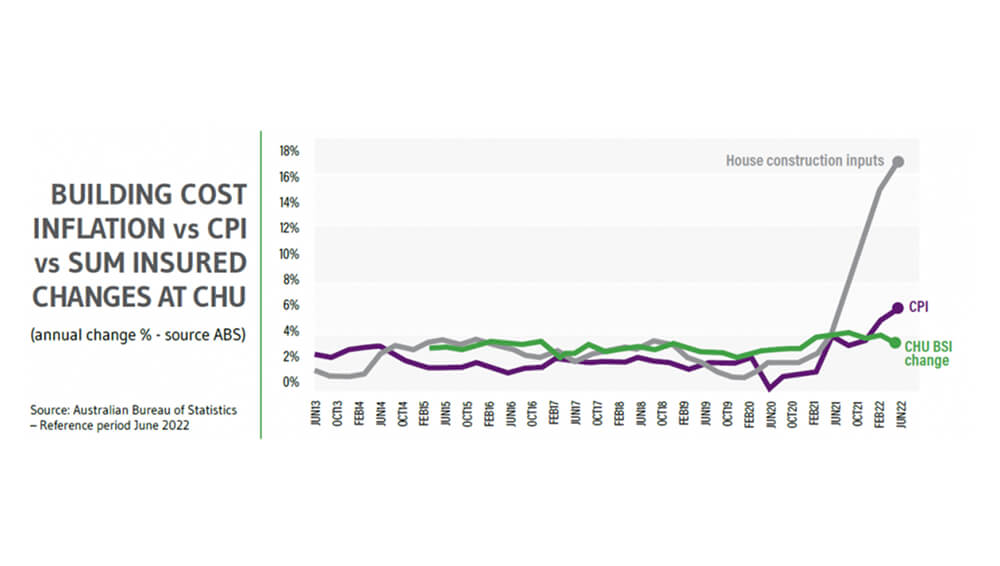
Recent escalations in building prices mean that if your building has not been valued in the past 12 months, there is a likelihood it is underinsured. The cost of construction has risen and is well outpacing CPI and this looks likely to continue into 2023.
It is important to review your current level of insurance, obtain an up-to-date valuation and check what level of indexing (increasing) applies to the sum insured for each policy.
Most states and territories require an updated valuation once every five years, but with the current pace of inflation and rising costs, we recommend doing this sooner rather than later to safeguard the property from being underinsured should a major event occur. The property should be insured for full replacement or reinstatement value and should also include removal of debris. Cover for legal costs and professional fees should also be included in your policy.
Maintenance and risk mitigation
There are a number of maintenance and risk mitigation steps strata property owners can take in order to mitigate risk.
Some of these are simple house-keeping practises such as regular inspections, cleaning out gutters, garden maintenance such as removing hazardous branches, clearing overgrown gardens, and ensuring repairs are completed in a timely manner.
It is also important to let your insurer know of any modifications to the building that may affect the cover such as installation of sprinkler systems, fire management plans, upgrade of electricals and site security.
Safety checks and inspections
Ensure maintenance schedules are up to date and that repairs have been checked for quality workmanship that will hold up in case of unexpected events.
Note that each lot owner is responsible for their own landlords or contents insurance, so it is important to ensure each owner has checked their own properties for potential hazards and ensure they are adequately insured.
Review your insurance cover and options
As part of your New Year’s Resolution planning, make one of them keeping your community safe by preparing for the unexpected.
Take the time to do a stocktake to ensure all the necessary insurance covers in place.
CHU is the leading provider of strata insurance for both residential and commercial strata.
As part of their residential strata insurance and commercial strata insurance policies, CHU offers cover for Property, Liability, Voluntary Workers, Fidelity guarantee, Office bearers’ legal liability, Machinery breakdown, Catastrophe insurance, Government audit costs and legal expenses and Lot owners’ fixture and improvements.
CHU also offers contents insurance and landlord insurance.
Get in touch with your local broker, strata manager or CHU BDM to start the year with the right advice for your strata community.
Once again, Brokers across Australia have voted CHU Underwriting Agencies the top award for Strata Cover in the annual broker survey conducted by Insurance Business Magazine.
This will be the fifth time that CHU, has been awarded the gold medal for these awards.
CHU CEO Kimberley Jonsson said:
“This award is particularly special, as it is recognition that comes directly from our key customers. I would like to personally thank all the brokers who voted for us and appreciate their continued support as we grow CHU to meet the rising demand and challenging market conditions.
Kimberley Jonsson, CEO, CHU
I would also like to thank the CHU team who are always customer focused in everything they do, from underwriting all the way through to claims.”
CHU, one of Australia’s largest and most awarded underwriting agencies has been in the strata insurance business for over 40 years. Winning this award is further confirmation of the importance brokers place on specialist knowledge when it comes to working with underwriting agencies.
Click here for the Insurance Business Magazine feature.
For further information and media enquiries contact us.
Across Australia, we are currently experiencing the third La Niña weather pattern in a row.
A typical La Niña season can bring higher rainfall across the country, increased possibility of tropical cyclones, and a longer monsoon season in the far north. This increased rainfall can help reduce bushfire risk, but will increase the likelihood and severity of flooding, not just in tropical Australia, but also in the south.
Strong winds are also a major factor in La Niña periods with the increased prevalence of cyclones and gale-force storms. Those intense winds not only cause severe damage on their own, but can also raise tide levels causing coastal and low-lying seawater inundation, and erosion.
All of Australia will feel the effects of this weather system, however those effects will vary from north to south.
Northern Australia will certainly witness not just more water, but also more potentially catastrophic winds, with a greater likelihood of cyclones and monsoons. In the southern parts of Australia, even as far south as Tasmania, river systems might potentially peak and undergo slow or flash flooding. Flooding can occur days after a severe weather front has passed, as rivers fill with run-off from catchment areas.
Prepare your strata property to mitigate damage that may arise from La Nina
If you are a strata property owner, it’s vital for you to ensure you have done everything possible to mitigate any damage that may come about from La Niña.
Please remember that “an ounce of prevention is worth a pound of cure” Benjamin Franklin
By taking proactive measures to prevent losses from La Niña risks you will be ensuring that you are minimising future increases to premiums and excesses.
What you can do in advance to minimise La Niña risks
Rainfall and hail
A good maintenance schedule to minimise potential for water damage to the property:
- Thoroughly check and clear gutters, drains, downpipes and balconies.
- Replace any deteriorating silicon on the windows and roof.
- Check roofs, especially on older buildings, for waterproof capabilities to prevent seepage into ceiling and wall cavities. Ensure tiles and roof sheeting is secure – these can not only cause leaks, but also dangerous flying debris in high winds.
- Check stormwater and flood inlet grates in basements and underground car parks to ensure they can handle sudden deluges.
Hailstorms can cause significant damage, cracking or even breaking skylights and windows, leading to rain damage to internal areas. Large hailstones can crack roof tiles, dent aluminium roofs and air conditioner units, block gutters, and result in water escaping into the building.
Contact the local state emergency services who will be able to assist by placing tarpaulins onto the roof or over damage windows.
Flooding
A few things to do for properties in areas that are prone to flood:
- Keep contents and appliances out of areas that are at risk of flooding.
- Encourage residents and businesses in units at, or below, ground-level to lift valuable items and electrical equipment off the floor.
- When there is the possibility of major flooding, strata committees should at least know where they can access sandbags in an emergency, if they don’t have barriers on hand already.
- Contact the local state emergency services for help.
High winds
Gale-force winds and cyclones can put building structures under strain, particularly windows. They can also cause secondary damage by dislodging trees and branches, and turning loose items into dangerous missiles. Regular maintenance of the property and gardens will help reduce the risk of damage. A couple of practical tips include:
- Cutting back trees and overhanging branches if they pose a risk of falling and damaging the building.
- Advise the building’s occupants to secure any items on balconies or in yards.
What you should do after La Niña strikes
Once the danger has passed, strata committees or their representatives should conduct a thorough inspection of all public areas on the property. A comprehensive report should be compiled, no matter how minor the damage.
The report should detail:
- Date and time
- The adverse weather conditions
- Damage caused by the weather event
- Take photos of the damage before repairs commence
- Previous condition of damaged area of the property
- History of maintenance or upkeep if applicable
- Any immediate rectification required and undertaken
- Expert assessments
- Plans for future repairs
- Mitigation strategies that have been put in place or will be put in place to prevent further damage.
The more detailed and extensive the report is, the easier it will be for insurers to advise on the potential recovery of costs to remedy the damage.
Recent escalations in building prices mean that if your building has not been valued in the past 12 months, there is a likelihood it is underinsured.
While it is commonplace for insurers to communicate the importance of adequate levels of insurance, this message is more critical than ever given the proverbial perfect storm of events that has led to contractor shortages and soaring inflationary costs across the construction sector.
It is generally well known in the strata building insurance industry that:
- There is a need to insure for full replacement and reinstatement value.
- Include removal of debris, professional fees and an allowance for cost escalation over a period of time.
- In most states and territories, there is a requirement to obtain a valuation at least once every five years.
The figure below demonstrates how sharply the cost of construction has risen and is well outpacing CPI, with the steady increase seen from the advent of COVID-19 now a far more steep increase for the year 2022. When you overlay CHU’s actual sum insured profile from across its strata portfolio, it is clear that sums insured are not even keeping pace with the CPI percentage in the graph, let alone the construction pricing index.
Source: Australian Bureau of Statistics (June 2022)
Regardless of specific strata legislation across Australia, it is important to ensure that bodies corporate have adequate protection for their single biggest asset.
Frequency of catastrophe events continues to rise, which means the chance of an insured suffering a loss is also increasing. CHU implores all bodies corporate to:
- Review when their building sum insured was last updated.
- Obtain a current valuation.
- Review what level of indexing applies to their sum insured on renewal in between updated valuations, to ensure they are not falling behind.
Without a directive from the insured or their appointed intermediary, CHU will automatically index the sum insured by a certain percentage at each renewal (please contact us for the exact percentage).
For any further information, contact your Business Development Manager or CHU office.
CHU is thrilled to announce the launch of LiveChat – an instant messaging service linking intermediaries to CHU’s customer service team during business hours. CHU is always looking for ways to improve our customer service and communications, with our customers being the central focus to everything we do. This is why we are launching LiveChat as an additional communication channel.
LiveChat will be available from chu.com.au during business hours and will provide fast responses to simple administration questions and requests that would otherwise require a phone call or an email.
What type of questions is LiveChat for?
- Certificate of currencies (COC) including noted requests
- Claims history requests
- Cancellation requests
- Policy amendments/endorsements
- Documentation requests
What type of questions is LiveChat not for?
- New quotes: You can request a new quote via StrataTech 24/7 through self-service access
- Claims: You can lodge a claim or obtain claim updates via StrataTech 24/7 though self-service access with our online claim form or Claims View
CHU is thrilled to announce the launch of “Claims View” in StrataTech.
Claims View will give intermediaries unprecedented ‘real time’ access to a customers claim file. This has been developed in consultation with our partners and not only will it allow access to the claim at any time of the day, but it also enables a response to any update requests quickly and easily.
“I am pleased that CHU can now offer our intermediary partners additional access to information. We know how much value this will add when they are managing claims for their customers. We will continue to work on further innovative ways to enhance StrataTech and the overall claims experience”.
David Gow, Head of Claims.
Claims View is available online via StrataTech 24/7, so there is no need to make a phone call or send an email to get an update on a specific claim.
From Claims View, the below can be seen:
- Claim number, lodgement number (if lodged online), date reported, and status
- Claims officer comments
- Policy details
- Incident details
- Claimant details
- Claim payment details
- Attachments which can be viewed and downloaded such as Loss Adjuster reports
- Auto emails that have been sent
- Financial status showing the outstanding reserve, amount paid and incurred.
Anyone with an existing login for StrataTech will automatically have access to Claims View.
For more information on how to locate Claims View within StrataTech please read our Claims View flyer.
For anyone who doesn’t yet have a login to StrataTech please reach out to your Business Development Manager for assistance. Alternatively you can contact CHU on 1300 361 263 or [email protected] for more assistance.
The Federal Government estimates that every year, more than 4500 fires across Australia are caused by cigarettes. One of the biggest causes of fire in apartments and other residential homes is cigarettes which have not been extinguished properly.
Fires in apartments can have a devastating effect on the whole apartment block. Apartment fires have the potential to spread heat, smoke and fire throughout the building very quickly, not only causing considerable damage but also putting the lives of residents at risk.
Some fires in apartments have been caused by a smoker on a balcony leaving it smoldering on an outside table on their deck. Or they flick it off their balcony and it lands on a balcony below, setting fire to items on the other occupant’s deck.
Increasing threat
Another increasing fire threat is overheating lithium batteries (officially known as lithium-ion batteries).
The greater use of these batteries has seen fires correspondingly increase. They are contained in everything from large-scale solar energy storage systems to hybrid and electric vehicles, and smaller scale devices like laptops. Most portable electronic devices use single lithium cells, such as cell phones, smart-watches and e-cigarettes. They are also now used extensively for higher-powered portable applications like power tools, remote-controlled vehicles, lawn mowers, bikes and scooters and even in children’s toys
Emergency Services departments warn that with the use of lithium batteries expected to increase over the next few years, this could result in a surge of preventable blazes.
Lithium batteries are extremely sensitive to high temperatures and highly flammable. They tend to degrade quickly due to heat. If a lithium battery pack fails, it will burst into flames and can cause widespread damage. Fires mainly start during charging.
Once lithium battery fires take hold, they are notoriously difficult to put out.
Apartment residents should be careful to keep them away from flammable material and ensure they use charging systems specifically manufactured for your product rather than less costly, unbranded versions.
Lithium batteries should not be left on a permanent charge— even overnight can trigger overheating. When the device is charged, it should be unplugged.
Be prepared
Strata communities can do a lot to minimise fire risks in their buildings.
Regular fire safety checks should be at the very top of the strata committee’s list. As strata property’s mandatory fire safety requirements will differ a little from state to state, each property’s strata committee should be aware of their local requirements.
Fire safety equipment, such as fire extinguishers, sprinklers and smoke alarms, should be serviced and maintained regularly to ensure they are in good working order and fire doors needed to be clear of any obstructions.
If there is a fire, it’s important the apartments have an evacuation plan, and all occupants are aware of it.
With the rise in sales of electric vehicles (EVs) in Australia, strata owners need to be prepared for the growth of EVs.
The environmental pluses of EVs have also added to their popularity immensely. In 2021, Prime Minister Scott Morrison and Minister for Industry, Energy and Emissions Reduction Angus Taylor released a plan to deliver Australia’s target of net zero emissions by 2050. EVs are tipped to be a major part of Australia’s move towards sustainability, with most car manufacturers expected to shift to manufacturing electric vehicles over the coming decade. This along with the price of fuel surging, there is growing urgency towards alternatives, such as electric vehicles.
Sales of EVs in Australia have tripled in the past 12 months, with more than 20,000 being sold. The push has been accelerated with state government rebates and a competitive market. New South Wales has the largest number of sales (7430), followed by Victoria with 6396.
At the same time there are still limited EV charging stations and, besides public charging stations, there will be a major demand for stations to be in new or existing buildings, such as strata properties.
A number of local governments are requiring many new property developments to be EV-ready. Developers will have to consider that, besides normal electrical usage, their buildings will need to accommodate the power used by EVs and stations within the car park.
What does this EV surge mean to existing residential strata properties and their owners?
It’s estimated that nearly 50% of those living in apartments in Sydney plan to have EVs within the next few years. A survey by strata energy adviser Wattblock shows that 83% of people are interested in installing EV charging stations.
Installing individual EV charging in few spaces in underground residential car parks is fairly easy, with a number of qualified electricians able to do the job. Likewise, it’s relatively cheap to install.
However, providing chargers for nearly every parking space remains an expensive and complex task. There are professional advisers in Australia able to assist. Likewise, new technologies are making mass stations in car parks more feasible.
There are a few issues when establishing a large number of EV charging stations in an apartment parking area.
The biggest issue is who pays for the electricity? Not every strata owner may want to have a charging station and want to pay for others to do so. Surveys shows that many strata owners want to see user-pays arrangement for individual car spaces. This may require dedicated metered supplies if metering hardware is not built into the EV charging units.
The additional power usage can also be an issue. The power supply to strata apartments is limited, with little spare capacity available.
The body corporate/owners corporation will need to discuss this with the strata manager, who, in turn, would need to discuss it with the building’s electrical engineer. The good news is most EV owners charge their vehicles overnight when the demand when normal high usage is less. Again, this may require professional advice on making the power system more flexible.
Security can also be an issue. There are smart charging systems available which can be locked and unlocked remotely.
There’s no doubt EVs are the future of sustainable transportation and strata owners will need to get onboard. The question is how and when are they going to be ready?
Much of Australia has been soaked. The latest flooding in Queensland and NSW is yet another climactic disaster the country has experienced in recent years.
But there is a serious after effect of flooding: mould. And the recent floods have seen its major impact on properties.
Prof Dee Carter, of the University of Sydney’s School of Life and Environmental Sciences, says Australians have seen a major increase in the mould in homes this year with the severe flooding following a humid La Niña summer. This had meant roofs, ceilings, and wood becoming more saturated and mould thrives on this.
In simple terms, mould is fungus growing on a surface that has been wet for 24 hours, aggravated by a high level of warm moisture in the air and poor ventilation.
The impact on a property can been disastrous. It can be present virtually anywhere, both indoors and out. It can grow in or on furniture, curtains and other fabrics (clothes), walls and timber.
Also, studies have shown that mould can impact on asthma and allergies. In extreme cases, people who suffer from immune deficiencies or weakened immune systems can have increased allergic or asthmatic reactions. It’s recommended you contact your health provider if you are concerned the mould infestation is affecting your health.
What do you do when mould strikes?
It’s important strata property owners or strata managers contact the property’s insurer as soon as possible, not only to lodge a claim but also advise of any related mould damage.
The owners or managers should document everything with photos and videos. It will mean the owners can provide their insurer with a record of the damage. Also, they should prepare an inventory of the damage – the more detailed and extensive, the easier it will be for insurers to advise on costs to remedy the damage and may speed up the claims process.
Owners should not try to fix damage until an insurance assessor has viewed the damage. However, if items in the house that are badly water damaged or mouldy they may be thrown out – just take photos or videos to support any potential claim. Soaked carpet , soft furnishings and mattresses should be disposed of as they retain moisture and encourage mould growth.
Ventilation is crucial after the flood. If the mould is minor keep the air flowing. If it’s safe to do so, open windows and turn on fans.
There are mould cleaners you can buy if the mould is minor. You can also use a mixture of white distilled vinegar/ or tea tree oil with equal parts water and spray the affected area with a spray bottle.
However, major mould infestation will require professionals to get rid of it. Owners and managers should discuss this with their insurer when they put in a claim. The affected area needs to be assessed by the insurer, some of whom have their own restoration panel to carry out the work.
FOOTNOTE: It’s not just “natural” flooding and the subsequent mould that could impact on properties. One of the most common strata claims is from internal water damage. A major problem is aging flexible braided water hose attached to a dishwasher or washing machine bursting and flooding the property. Some 1500 litres of water per hour may gush through the property and adjacent strata properties.
Climate change and biodiversity loss are amongst the biggest threats facing planet earth today. Some people believe the task of reducing our climate risks is in the “too hard basket” and beyond their ability. But we can – every little bit helps.
The strata industry, in particular, can make a valuable and impactful contribution to combatting this global problem. 38% of Australia’s current carbon emissions come from heating, lighting and cooling and accounts for 39% of our energy use.
As a significant contributor to emissions, the strata industry, including owners, strata managers and strata service providers, need to be on the front foot with sustainability programs and initiatives.
Insurers, who face serious risks from climate change especially, need to be at the forefront.
Everything that we do at CHU is viewed through our customer lens. Our objectives and our deliverables that address emerging and ongoing business considerations must successfully pass through these filters. One of these filters is ‘’Environment and Sustainability’’.
CHU’s strategy includes a major sustainability element and focusses on leading the way for change in the strata industry. For some time we have implemented a number of environmental initiatives that are proving successful, and we are now looking at trialing some new initiatives to increase the positive impact. In 2022 we will continue to work with SCA National on the Sustainability Development Goals for strata.
CHU’s carbon neutral journey so far …
Since 2019, CHU has been working with environmental scientist/explorer Tim Jarvis’s Forktree project in combating climate change and biodiversity loss.
CHU is offsetting its carbon footprint by planting thousands of trees on degraded farmland on the Fleurieu peninsula in South Australia to restore its pristine condition. Last year more than 1700 trees were planted, and this year’s planting will make CHU carbon neutral for the third year.
Each year, CHU also asks the suppliers to contribute to the Forktree Project rather than send thank- you gifts. Last year CHU’s service providers contributed $15,000. CHU aims to work with its service providers to also become carbon neutral in 2022/23.
Reducing the impact of claims waste on landfill
More than a third of the waste generated in Australia ends up in landfill, with insurance clean-up and repair work material a significant contributor.
CHU has been piloting an initiative in Queensland with eco waste managers Handel Group to lessen the impact on landfill since 2020.
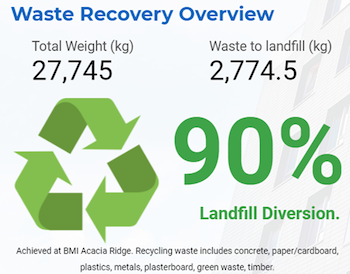
CHU uses unique handel: FLEXiSKiPs to collect and remove the waste. The skips are made from recycled material and can be easily erected on sites. The waste materials are later moved to handel: recycle partners to recycle.
A landmark was reached in May 2021 with 90 per cent of the material gathered in the pilot scheme being recycled.
CHU is now encouraging its panel of builders across Australia to use the skips so that the waste can be recycled. In 2022, panels in Victoria, South Australia and Tasmania will be able to use the process.
Trialing environmentally friendly cleaners and paints
CHU is currently trialing two initiatives with a Victorian panel supplier with a view to rolling them out nationally in 2022.
A range of products are being trialed that are used for commercial cleaning when properties need to be thoroughly cleaned as part of restoration work.
CHU is trialing the Actichem Responsibly Green cleaning range, which was developed to provide environmentally sustainable solutions.
CHU is testing the range’s disinfectant; mold remover; and air freshener. The products utilise plant extracts, antimicrobial and bio-enzyme technology to minimise their impact on the environment.
CHU is also trialing low VOC paints through Dulux and Taubmans. These are paints that contain less “Volatile Organic Compounds” (VOC) or VOC Solvents than traditional coatings. High levels of VOC solvents contribute to the formation of pollution and reduce the indoor air quality.
In order to minimise the level of VOCs released, external bodies such as the “Green Building Council of Australia” (GBCA) established “Green Star” Industry Standards in order to control the level of VOC solvents that can be incorporated into various paints during manufacture.
Time for action
The time for action by the strata industry, the insurance industry and other industries is now.
As Deloitte’s partner for energy transition and renewables, John O’Brien, told the ABC, most businesses need to start grappling with what to do about climate change, if they have not already. ”If you want to have a business that’s going to be running in 10 years, then you need to be thinking about how you’re going to plan that strategy to be in business. If you’re taking no [climate] action now, and the world is changing fast, companies that don’t change with the evolving world are effectively not going to survive.”
How are you travelling on the sustainability journey?
Disclaimer: CHU Underwriting Agencies Pty Ltd (ABN 18 001 580 070, AFS Licence No: 243261) acts under a binding authority as agent of the insurer QBE Insurance (Australia) Limited (ABN 78 003 191 035, AFS Licence No: 239545). Terms, conditions, limits, deductibles and exclusions apply to the products referred to above. Any advice in this article is general advice only and has been prepared without taking into account your objectives, financial situation or needs. Before making a decision to acquire any product(s) or to continue to hold any product, we recommend that you consider whether it is appropriate for your circumstances and read the relevant Product Disclosure Statement (‘PDS’), Financial Services Guide (‘FSG’) and the Target Market Determination (‘TMD’) which can either be viewed at www.chu.com.au or obtained by contacting CHU directly on 1300 361 263.
CHU, one of Australia’s leading strata insurance specialists, has become one of the few companies in the country to be recognised as a Family Inclusive Workplace by the Parents at Work organisation and UNICEF Australia.
Parents At Work, which provides work and family education and policy advisory services to companies, partnered with UNICEF Australia last year to improve work life wellbeing, inclusion and equity outcomes for families by introducing a set of certifiable National Work and Family Standards for employers.
CHU announced today it has joined a select number of Australian companies to be granted certification as a Family Inclusive Workplace™.
The certification follows CHU introducing in July last year a fully flexible hybrid work model open to all staff at every level. The model gives people the choice of where and when they do their best work, whether this be in the office, at home or another location or a combination.
“CHU has always worked hard to ensure our company is supportive of families and we are extremely proud to be officially recognised as a Family Inclusive Workplace,” said CHU CEO Kimberley Jonsson.
“Diversity and Inclusion is one of our three strategic pillars. This certification not only recognises that CHU has been supportive of families of every type; it’s our commitment to the ongoing improvement, measurement and management to ensure this remains an embedded part of our DNA,” she said.
“Helping our families has become even more important in recent years with the pressures of the pandemic.”